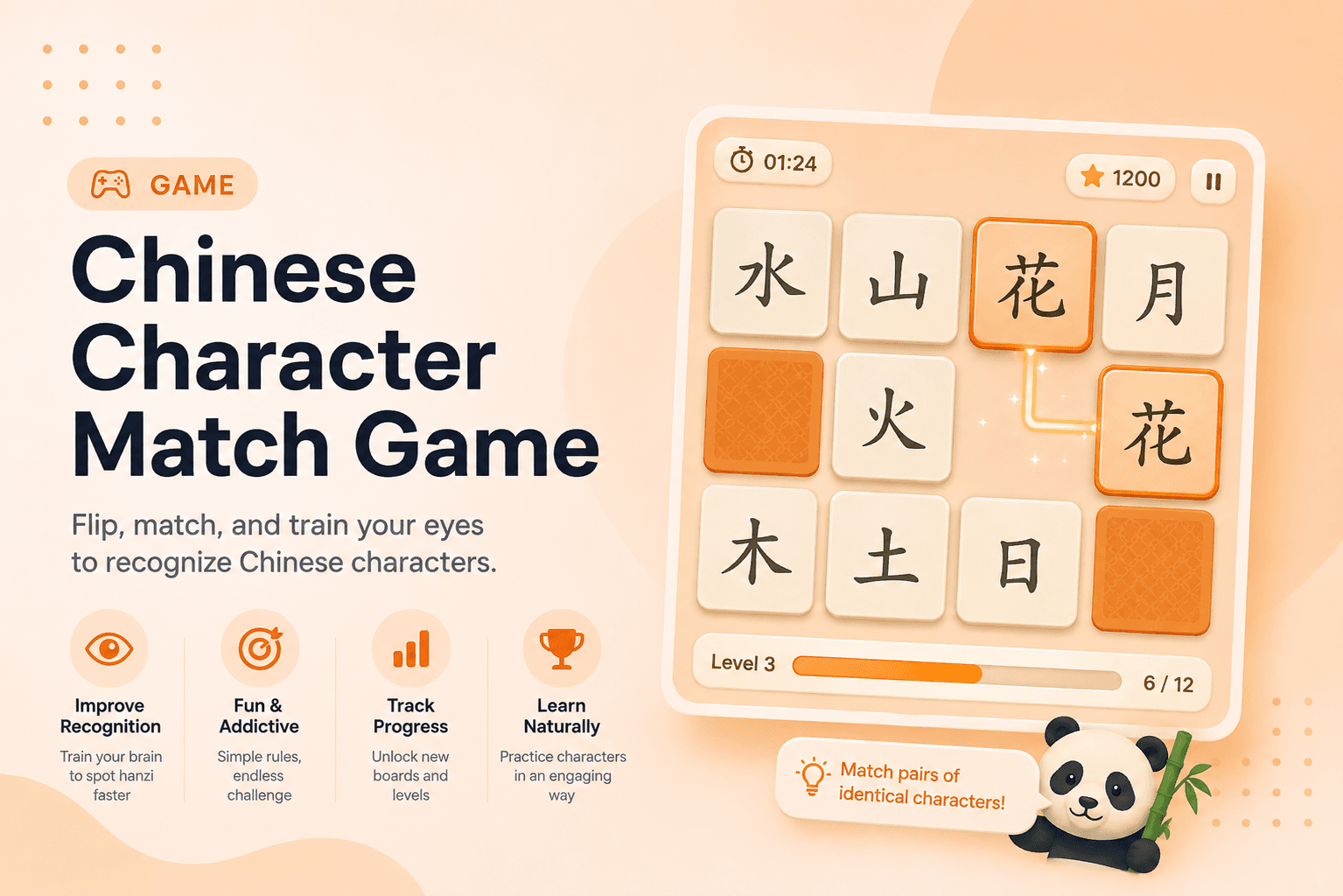

The Chinese Character Memory Match game is a free, focused way to improve hanzi recognition. By matching identical characters without pinyin clues, you train your eyes to notice the shapes and details that make each Chinese character unique.
If characters such as 人 and 入, 日 and 目, or 未 and 末 still look confusing, this kind of visual practice can help. The game begins with a small 2×2 board, gradually introduces larger boards, and saves your progress in your browser—making it easy to build a short Chinese study habit.
Play Chinese Character Memory Match →
Why Chinese Character Recognition Matters
Learning to recognize Chinese characters is different from memorizing a pronunciation or English translation. To read Mandarin with confidence, you need to see a character and identify it quickly—even when there is no pinyin underneath it.
Strong character recognition helps you:
- read signs, menus, messages, and graded readers more smoothly;
- tell similar-looking hanzi apart;
- connect characters with vocabulary you have already studied;
- spend less time decoding each sentence; and
- build the visual foundation needed for faster Chinese reading.
Traditional flashcards are useful, but repeating the same card format can become passive. A memory matching game adds a simple task: remember where a character appeared, find its identical pair, and pay attention to the details before choosing.
Why Memory Match Works So Well for Hanzi Practice
1. It makes you look closely at character shapes
Chinese characters are built from strokes and recurring components. A short line, an extra stroke, or a different proportion can change one character into another.
In Chinese Character Memory Match, every choice requires visual comparison. You are not only asking, “Have I seen this before?” You are also asking, “Is this exactly the same character as the other tile?” That small difference encourages careful observation.
The later levels include lookalike characters, giving you practice with pairs that learners often mix up. Recognizing these differences is an important step toward accurate reading.
2. There is no pinyin on the cards
Pinyin is essential when learning pronunciation, but it can also become a shortcut. When pinyin appears beside hanzi, learners sometimes read the Latin letters first and barely process the character.
This game removes that shortcut. The cards show hanzi, so your attention stays on the character itself. You can use a Pinyin Converter separately when you want to check pronunciation, but the matching activity remains focused on visual recognition.
3. Active recall is more engaging than rereading
Simply looking over a vocabulary list can create a false feeling of familiarity. Recognition becomes stronger when you must retrieve information or make a decision.
During each round, you remember tile locations, compare characters, and test your choice immediately. A correct pair stays visible; an incorrect pair flips back. That feedback keeps you involved and makes every turn part of the practice.
4. Short rounds make daily practice easier
Consistency matters more than an occasional long study session. A quick matching round can fit into a commute, a study break, or the final few minutes of a lesson.
The first level uses only two pairs on a 2×2 board. As you continue, the game grows to 2×3, 2×4, and then 3×4 boards. This gradual progression makes the first step approachable while leaving room for a greater challenge.
5. Progress creates a reason to return
There are 30 progressive levels to clear. Completing one level reveals the next, moving from simple characters to everyday vocabulary and more easily confused forms.
The game also records your best move count in your browser. You can replay a level and try to match every pair more efficiently—not as a test of your Chinese level, but as a motivating way to repeat the same visual material.
What Makes This Chinese Character Game Beginner-Friendly?
Many Chinese learning games try to combine vocabulary, tones, grammar, listening, and speed in one activity. That can be useful, but it can also overwhelm a beginner.
Chinese Character Memory Match has one clear goal: find two identical hanzi.
That simplicity makes it useful for:
- complete beginners becoming comfortable with written Chinese;
- HSK learners who want extra character exposure;
- visual learners who remember shapes and positions well;
- returning students refreshing characters after a break; and
- teachers and parents looking for a quick warm-up activity.
You do not need an account, and you do not need to know every character before playing. Start with Level 1, learn how the board works, and let repeated exposure make the shapes more familiar.
How to Get More Learning Value from Each Game
Matching identical tiles can strengthen visual recognition, but it works best when combined with meaning, pronunciation, and real vocabulary. Use these simple strategies to turn each round into a stronger study activity.
Say what you know
When you reveal a character, say its pronunciation or meaning if you know it. If you do not know it, focus on recognizing its shape and look it up after the round. Avoid stopping after every tile; keeping the game flowing makes the activity enjoyable.
Notice one distinctive feature
Before flipping a tile back, identify a visual clue: a component on the left, an extra horizontal stroke, an enclosed shape, or the overall balance of the character. This is especially helpful with lookalike hanzi.
Replay for accuracy, not just speed
The game counts moves rather than putting you under a timer. On a second attempt, try to reduce random guesses. A lower move count can show that you remembered both the characters and their positions more clearly.
Review the characters in another format
After playing, add unfamiliar vocabulary to Memory Cards or write the characters by hand. Matching supports recognition; flashcards, handwriting, reading, and listening connect that recognition to meaning and usage.
Keep sessions short and regular
Try one or two levels each day instead of rushing through every board. Spacing practice across several days gives you more opportunities to forget slightly and recognize the characters again.
Memory Games vs. Flashcards: Which Is Better?
You do not have to choose one.
Flashcards are better for testing a direct connection, such as hanzi to meaning, meaning to pronunciation, or a word to an example sentence. Memory matching is especially good for visual attention, repeated exposure, and distinguishing shapes.
A balanced routine might look like this:
- Play one Chinese Character Memory Match level as a warm-up.
- Review unfamiliar words with Memory Cards.
- Read a short text containing familiar characters.
- Check pronunciation with the Pinyin Converter.
- Return to the game later and replay the level with fewer guesses.
For more variety, browse all free Chinese learning games or practice reading while singing with Chinese Karaoke.
Frequently Asked Questions
Is Chinese Character Memory Match free?
Yes. You can play the Chinese Character Memory Match game online for free. Start from the level selection page or go directly to Level 1.
Do I need to know pinyin before playing?
No. The matching cards intentionally do not show pinyin. The goal is to recognize and compare Chinese character shapes. You can study pronunciation alongside the game with other tools.
Is the game suitable for beginners?
Yes. The first board is a simple 2×2 grid with two matching pairs. Later levels gradually add more tiles and more challenging characters.
Will a memory game teach me to read Chinese?
Not by itself. It trains an important subskill: fast, accurate character recognition. To learn to read Chinese, combine it with vocabulary meanings, pinyin and tones, sentence-level reading, listening, and regular review.
Does the game save my progress?
Yes. Unlocked levels and best move counts are saved locally in your browser. Because the progress is stored on that device, it may not follow you to another browser or device.
How often should I play?
A few short sessions each week are more useful than one long session followed by no review. Play a level, revisit it later, and mix the game with other forms of Chinese practice.
Final Thoughts
Chinese characters become easier to read when their shapes stop feeling like unfamiliar drawings and start becoming recognizable patterns. A memory match game supports that transition by making you inspect, compare, remember, and revisit hanzi in a low-pressure format.
It is not a replacement for vocabulary study or reading practice. It is a focused training tool—and that focus is exactly why it works so well for learners who want to recognize Chinese characters faster.
Start with a 2×2 board, unlock all 30 levels, and train your eye to recognize hanzi—one matching pair at a time.
Keywords:
Chinese character memory match, Chinese character game, learn Chinese characters, hanzi recognition game, Chinese memory game, free Chinese learning games, HSK character practice, recognize Chinese characters, hanzi matching game, Mandarin learning game